 Contact

Do you have any questions,
need technical support or
would like to place an order?

Order form
Kuraray Europe GmbH Sustainability Blog Invisible flood protection: How SentryGlas® makes architecture more resilient
 Contact
Do you have any questions,
need technical support or
would like to place an order?
These days, shatter-proof glazing is standard in architecture and vehicles. By contrast, one related aspect has only recently started to become more important: flood-resistant laminated glass. Given the increased frequency of severe weather events and rising water levels, buildings need better protection – without any reduction in transparency, visual appeal, or accessibility. That is made possible by a technology that was originally developed for hurricane-proof applications in the United States and is now used in spectacular glass constructions such as the Grand Canyon Skywalk, the Enzo Ferrari Museum in Italy, and the Zhangjiajie Glass Bridge in China: SentryGlas® ionoplast interlayers from Kuraray. Now this high-performance material is becoming more significant for efficient and sustainable flood protection.

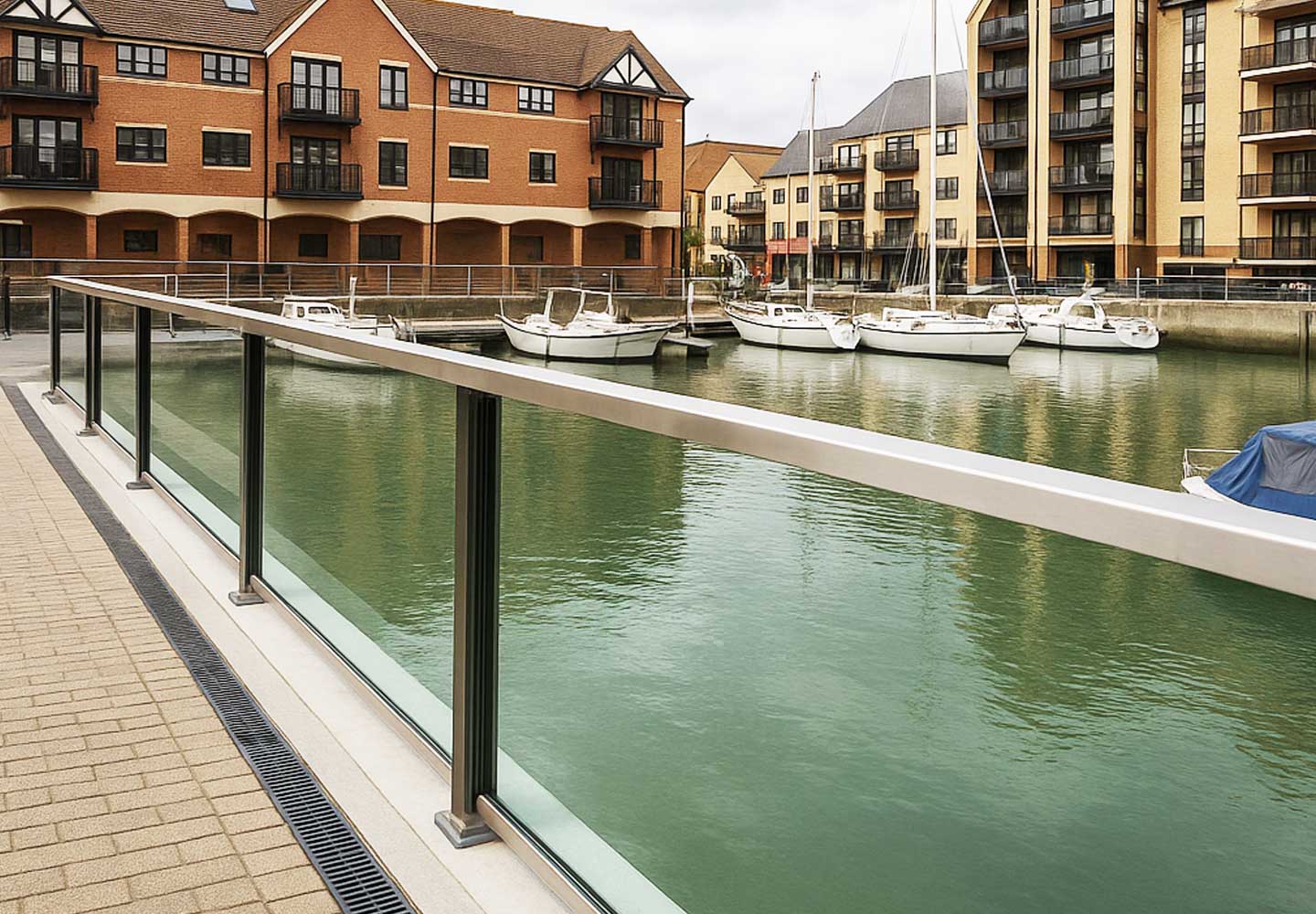
Urbanization and more frequent climate-related flooding are driving demand for new solutions. Buildings need to be sealed and infrastructure protected without massive barriers that interfere with architectural design or block views. In the past, technical constraints made it almost impossible to create robust glass doors, transparent facades, and elegant flood barriers. Today, modern laminated glass opens up completely new design options.
Flood-proof glazing has a key advantage: As well as providing protection, it can be integrated seamlessly into the architectural environment. Public spaces, coastal constructions, and critical infrastructure can be designed with safety in mind without compromising on transparency or user-friendliness.
SentryGlas® from Kuraray’s Advanced Interlayer Solutions (AIS) division, a world leading supplier of high-performance glass interlayers, is a safe and sustainable solution that meets the special requirements of flood protection. It is particularly suitable for the following types of structure:
From skyscrapers to subway stations and coastal infrastructure, SentryGlas® meets the highest technical requirements – and sets standards for durability in areas exposed to moisture.

»Flood glazing with SentryGlas® interlayers broadens the horizons of glass design. It also keeps floodwater at bay and reliably withstands impacts from debris. Even if the glass breaks in places, the interlayer remains stable, keeping the building envelope intact.«
Allan Gibson
AIS Global Product/Marketing Segment Manager, Kuraray Europe GmbH
Laminated glass is made of two or more layers of glass bonded by a transparent interlayer. Interlayers range from flexible (for example, Trosifol® polyvinyl butyral [PVB] interlayers) to extremely stiff (for example, ionoplasts such as SentryGlas® or SentryGlas Xtra® [SGX®]). The glass can be tempered, toughened, heat-strengthened, or chemically treated to meet a wide variety of safety, structural, and environmental requirements.
Globally, laminated glass is used for traffic infrastructure, in high-security environments, and increasingly in areas that are prone to flooding, where it plays a key role in the integrated protection. Examples include buildings and fencing along coasts and rivers. Laminated glass with SentryGlas® interlayers fulfills the multifunctional criteria defined by many regions and also meets a wide variety of performance expectations.

These properties make SentryGlas® ideal for systems where maximum safety and high visual quality are equally important.

In the future, flood-resistant glazing will be a key element in resilient architecture. It brings together three factors that were rarely combined in climate protection in the past: safety, sustainability, and an attractive appearance.
To make sure this technology becomes established worldwide, standardization bodies, planners, developers, and manufacturers should jointly drive forward its development, define specifications, and support the widespread use of this important solution for more resilient architecture.
The future of architecture is not simply resilient, it’s transparent. And it’s starting now!

© Copyright 2024. All rights reserved.
Products & Solutions
Sustainability
